The demobilization of all AmeriCorps teams — particularly those under AmeriCorps NCCC (National Civilian Community Corps), which are often deployed for disaster response — would have serious short- and long-term implications on the U.S. disaster response landscape. Here are some key effects to consider:
1.
Reduced Surge Capacity During Disasters
AmeriCorps teams are often first responders during major disasters, especially for:
Debris removal
Shelter operations
Sandbagging
Damage assessmentsWithout these teams, local emergency managers may lack the surge manpower needed in the first 72 hours after a disaster.
2.
Slower Recovery Timelines
AmeriCorps NCCC and other service programs often assist in:
Rebuilding homes
Volunteer coordination
Long-term recovery operationsWithout their support, recovery will likely:
Take longer
Cost more (due to need for private contractors)
Increase stress on local governments and nonprofits
3.
Increased Vulnerability for Underserved Communities
AmeriCorps teams frequently serve vulnerable populations who might otherwise be overlooked:
Elderly residents
Low-income families
Rural or isolated communitiesThe absence of these teams could widen inequity in disaster response and recovery outcomes.
4.
Strain on Partner Agencies
Agencies like FEMA, the American Red Cross, and local VOADs (Voluntary Organizations Active in Disaster) rely heavily on AmeriCorps for:
Logistics
Volunteer coordination
Community engagementLosing AmeriCorps means these partners must either:
Overwork their staff
Leave gaps in response
Divert funds to cover what AmeriCorps volunteers did for free
5.
Loss of a Trained Civic Workforce
AmeriCorps teams are trained in:
CPR/First aid
Incident Command System (ICS)
FEMA certificationsDemobilizing the program means losing a pipeline of future emergency managers and disaster volunteers.
6.
Long-Term Impact on Community Resilience
AmeriCorps often engages in mitigation and preparedness work:
Educating residents
Strengthening infrastructure (like fire breaks or flood control)Without them, communities may face more severe impacts from future disasters.
Possible Mitigations (if demobilization is unavoidable):
Expand funding to other national service partners (like Team Rubicon or state-level Conservation Corps)
Establish local Civilian Climate Corps or community resilience hubs
Offer incentives for retired professionals or faith-based groups to help fill the service gap
It is often said that changing your thinking can change your life, but true transformation occurs when you also change your actions. My coaching approach is designed to help you do both, while holding you accountable to operate from your “Best Self.”
I have worn many hats in my life – Athlete, Warrior, Businessman, and Coach. Through both successes and setbacks, I have gleaned valuable lessons that I am eager to share with you for your personal growth.
In today’s fast-paced world filled with increasing uncertainties, traditional practices in business, relationships, and personal development are being put to the test. I believe that adapting to new attitudes and actions is essential for meeting today’s challenges. By guiding you to enhance your personal resourcefulness, I aim to spark your inner potential.
Having lived and worked across different continents, I have been enriched by the diverse perspectives and wisdom of various cultures. As a Businessman and Personal Effectiveness Coach, I have studied what strategies work effectively across different cultures and learned the importance of flexibility and creativity.
Whether on the athletic field, in the classroom, or in the boardroom, I have found success in coaching individuals to achieve higher levels of resourcefulness, effectiveness, and accomplishment. Being referred to as “Coach Jim” has been a privilege, and I take pride in helping others realize their full potential.
Learn more about me here:
APPROACH
My Formula for Success is PG + PC, where PG stands for Personal Growth and PC for Personal Contribution. Through tailored exercises and insights, I aim to guide you in uncovering your “Best Self” by focusing on personal growth and making meaningful contributions. As your coach, I am here to support you in developing core competencies, self-reliance, and resilience, leading you towards your highest potential by cultivating effective habits and discarding unproductive ones.
Resourcefully implementing effective habits is the key to success in all aspects of life – be it work, play, or relationships. I believe that information and wisdom only translate into valuable skills when they are actively practiced as habits. Effective coaching requires mutual accountability between the coachee and the coach to ensure consistent progress.
WHAT IS COACHING
Coaching is a collaborative, solution-focused, results-oriented process where the coach facilitates personal and professional development, self-directed learning, and enhanced work performance of the coachee. Throughout our partnership, expect direct, personalized, and sometimes challenging conversations that encourage growth and development. Successful coaching requires active engagement and cooperation from both the coachee and the coach.
It is important to note that coaching is distinct from therapy and does not aim to address psychological issues. However, alternative tools and techniques such as NLP, Hypnotherapy, and Time Line Therapy may be utilized by the coach. The coachee is required to disclose any past or ongoing psychological treatments, and should any psychological concerns arise during the coaching process, the coach may recommend seeking assistance from a qualified specialist.
All information shared during coaching sessions and any written documentation remain strictly confidential to uphold the trust and integrity of the coaching relationship.
As your coach, I commit to:
– Clearly outlining the coaching expectations and parameters
– Coming prepared for each session
– Providing relevant materials to support your progress towards your goals
– Ensuring complete confidentiality, unless explicit permission is given to share specific issues with others
DEVELOPING PERSONAL LEADERSHIP
“Vision without Action is merely a daydream,
Action without Vision is a terrifying nightmare.”
– Japanese Proverb
Leadership embodies a “can-do” attitude, teamwork spirit, and a relentless commitment to success. If leadership is more art than science, my coaching guidance aims to help you cultivate and refine the skills and tools necessary to become a more adept and effective leader.
As you explore the following concepts, envision how these principles can be integrated into your personal toolkit through practice:
– Timely Decisiveness
– Bias for Action
– Trusting Your Instincts
– Enhanced Observation Skills
– Effective Communication and People Skills
– Synergizing Courage, Action, and Responsibility
Despite the plethora of management and leadership techniques documented in countless books, I maintain that effective leadership is an art form that can be honed through practice. Effective strategies must be flexible and adaptable to different cultural contexts while staying attuned to ongoing changes and challenges.
Our coaching sessions will focus on sharpening your awareness and mindfulness to discern the nuances of complex situations, providing a foundation for making sound leadership decisions. Embracing timely decisiveness, intuition, and a proactive mindset are essential elements in honing your leadership skills.
In the words of Colin Powell, achieving success often involves gathering essential information and then trusting your instincts to guide you forward. As your coach, I am here to empower you with the skills, insights, and confidence to trust your judgment, make informed decisions, and take decisive action.
In conclusion, effective leadership requires a harmonious blend of management principles, observation skills, and interpersonal acumen. By embracing courage, initiative, and accountability, you can pave the way for personal and organizational success.
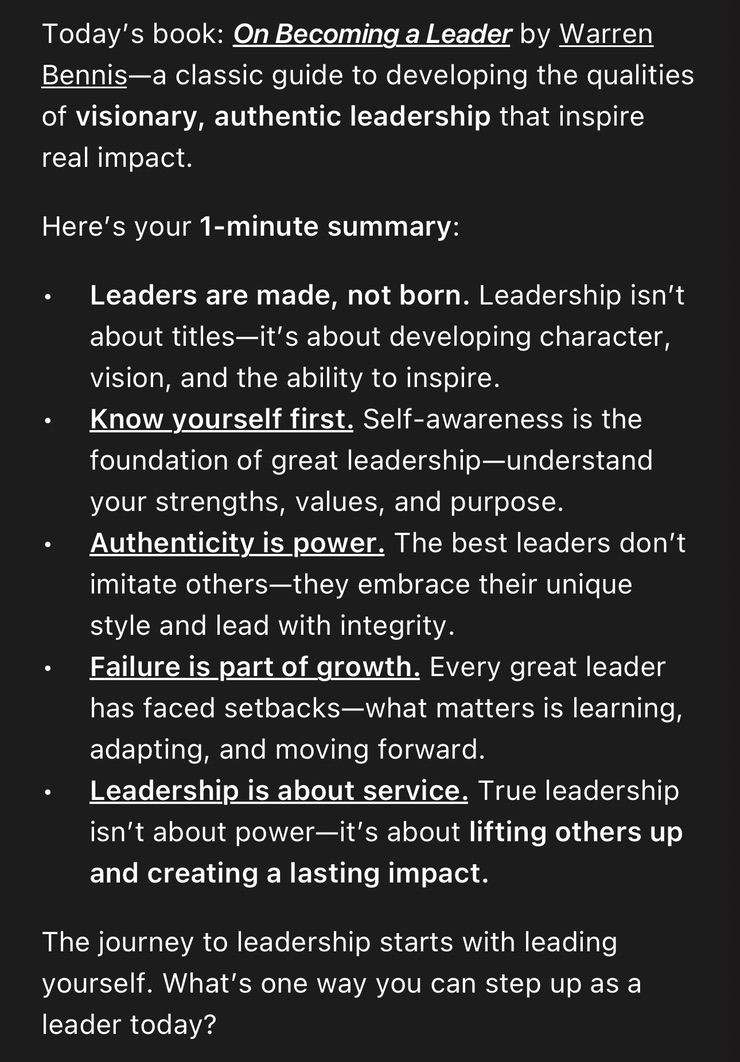
Below is a summary written by Brian Johnson, CEO of Heroic Benefit Corp, of Warren Bennis book, “On Becoming a Leader”. See more info on Heroic at: https://bit.ly/4c0nDBS
“How we spend our days is, of course, how we spend our lives. What we do with this hour, and that one, is what we are doing. A schedule defends from chaos and whim. It is a net for catching days.”
— Annie Dillard
The shortness of life is a universal truth. No matter how long we live, our time is finite. And once it’s used, spent or invested, you can only ponder how you spent your life or time yesterday in retrospect. In light of this reality, it’s essential to make the most of every moment and defend your time against the chaos of life.
Every day endless tasks and distractions that compete for our time and attention. Whether it’s work obligations, social engagements, or personal responsibilities, our schedules can quickly spiral out of control, leaving us stressed, burned out and exhausted. However, by cultivating a combination of productive life habits, we can learn to defend our time and maintain a sense of balance.
M. Scott Peck, psychiatrist and best-selling author was right when he said, “Until you value yourself, you won’t value your time. Until you value your time, you will not do anything with it.” These habits are helping me defend my limited time.
Start with time boundaries. Create a schedule that includes time for work, exercise, family, friends, and personal hobbies.
Start each day with intention. Take a few minutes the night before to set intentions for how you want to spend your day.
Start your day with a “proactive morning routine” that puts your most important tasks on top of your agenda.
Use the “no email first-hour” rule to avoid getting sucked into your inbox first thing in the morning and instead focus on your most important tasks.
Use the “power hour” technique to tackle essential tasks during your most productive time of day.
Use the “power of three” technique to focus on three high-priority tasks each day and accomplish them before moving on to other tasks.
Don’t sweat the small stuff. It’s impossible to avoid all of the challenges and setbacks in life, but it’s important to learn not to sweat them.
Create a “time budget” to allocate your time based on priorities.
When in doubt, say “no” graciously and without guilt.
Unsubscribe from email lists that don’t add value to your life.
Practice deep work, dedicating uninterrupted time to your most important tasks. Resist reacting to demands during the process.
Try incorporating “flow activities” into your routine, such as playing music or drawing, to promote creativity and focus.
Use a minimalist workspace with only the essentials to reduce distractions and increase concentration.
Practice box breathing or other deep breathing exercises to reduce stress and increase focus.
Set aside “buffer time” in your schedule to account for unexpected tasks or delays.
Use a time-tracking app or journal to track how you spend your time daily to identify time sucks.
Use a morning walk or run to start your day with a burst of energy and mental clarity.
Take a digital Sabbath, such as a day or weekend, where you disconnect from all electronics to recharge and refocus.
Practice the 5-hour rule: Devote 5 hours each week to deliberate learning stay ahead of the curve, and grow.
Practice “active listening” in your conversations to improve communication and build deeper relationships.
Cultivate a sense of humour by finding joy in the little things.
Practice a digital curfew, avoiding screens at least an hour before bedtime.
Limit your intake of news and media to avoid getting distracted by negative information and events. Filter your news sources.
Use a time-tracking app or journal to identify time-wasting activities and adjust your habits accordingly.
Use commute time or other “dead” time to catch up on reading, learning, or other learning activities.
Build in time for creative pursuits, such as playing music, painting, or solitude walks, to help you recharge and find joy in your free time.
Use the “digital sunset” rule to avoid overuse of technology before bedtime and instead focus on winding down and relaxing before sleep.
Use the “two-minute rule” to quickly tackle small tasks as they come up throughout the day.
Incorporate “micro-moments” of self-care throughout the day, such as taking deep breaths or doing a quick walk or stretch.
Incorporate “active rest” into your routine — power naps, brisk walks, or short contemplative time work best.
Experiment with different productivity methods to find what works best for you. Don’t stick with a system without real results.
Use the “do not disturb” feature on your phone during focused work time to minimise distractions.
Make time for self-reflection to evaluate your goals and priorities and make necessary adjustments.
Use a “distraction list” to jot down any thoughts or ideas that come up during focused work time and then address them later.
Practice the “most important tabs” rule. Close all unrelated browser tabs when “mono-tasking.”
Unfinished tasks create psychological tension. Complete tasks or write down unfinished tasks to reduce cognitive load.
Learn to adapt to change and uncertainty to maintain a sense of control and reduce anxiety over things you can’t control.
Use a digital detox day or weekend to unplug and reconnect with yourself or your social connections.
Limit the number of decisions you make daily to conserve mental energy by scheduling “decision time” on your calendar.
Use the “brain dump” technique to get all your ideas and tasks out of your head and onto paper, so you can prioritise and organise them effectively.
Find meaning in challenges. Use difficult times as an opportunity to grow, learn, and find deeper meaning in life.
Remember to leave room for spontaneity and fun, and don’t let your schedule become too rigid or inflexible.
Daily reflection can improve contemplative intelligence “Thinking: the talking of the soul with itself.” —Plato
Build a few minutes of daily reflection into your life.
Allow your brain to make better connections: your intellectual growth depends on it. Allow yourself 10 to 15 minutes daily to contemplate. A daily contemplation habit makes you smarter and more resilient. Over time, it builds mental flexibility, allowing you to see and interpret new information in new ways. It helps you stay curious and open-minded, which is essential in a rapidly changing world. It also enables you to maintain perspective, which is crucial when things get tough. In short, it makes you a better thinker overall. So why not make it part of your routine? Start with 10 minutes every morning before you start your day. Or make it a wind down routine before bed. Sit comfortably somewhere quiet and still — away from distractions like the TV or music — and think, reflect or ponder these questions: What am I feeling right now? What do I need right now? What’s going on inside me right now? What’s happening outside me right now? Where do I want to go next? What would make my life better right now? Getting back within can help you find a way forward.
Author Brad Stulberg on why self-awareness is critical to an optimal routine. The bottom line is that the only way to an optimal routine is through astute self-awareness — not mimicking what other people do — and experimentation. The more you can match your activities to your energy levels, the better. The more you can figure out which types of environments stimulate your best work, the better.”
Below is a summary written by Brian Johnson, CEO of Heroic Benefit Corp, of Charles Dugigg book, “The Power of Habit”. See more info on Heroic at: https://bit.ly/4c0nDBS
 Musings
  No Comments
  1.
1.  2.
2.  3.
3.  4.
4.  5.
5.  6.
6.