Browsing "Musings"
Sep 26, 2026 - Musings    No Comments

The Way of Excellence

The following is a summary of Brad Stulberg’s book, The Way of Excellence through the lens of AI Literacy, Stoicism, and Precision Leadership.

The central idea of The Way of Excellence can be expressed in distinctly Stoic terms:

True excellence is less about what you acquire or achieve and more about the person you become through disciplined pursuit of what matters.

That closely resembles the Stoic conception of aretē—excellence of character. For Epictetus, Seneca, and Marcus Aurelius, the good life was not principally about status, wealth, comfort, or applause. It was about developing the capacity to think clearly, govern yourself, act courageously, treat others justly, and respond wisely to circumstances you cannot control.

That makes Stoicism an excellent philosophical foundation beneath Stulberg’s model.

1. Excellence begins with character, not achievement

Stulberg distinguishes true excellence from “pseudo-excellence”—the pursuit of status, recognition, optimization, productivity, and external validation.

The Stoics made essentially the same distinction nearly 2,000 years ago.

They regarded wealth, reputation, position, popularity, and even many external accomplishments as things that may be desirable but do not determine whether a person lives well.

What matters most is character.

This produces a powerful educational distinction:

Achievement asks:
“What did I accomplish?”

Excellence asks:
“How well did I perform?”

Stoicism asks:
“Who did I become while doing it?”

For Precision Leadership, all three matter—but character governs the other two.


2. Control what you can control

Perhaps the clearest connection is the Stoic Dichotomy of Control.

Some things are substantially within our control:

  • Our judgments
  • Our attention
  • Our preparation
  • Our effort
  • Our choices
  • Our response
  • Our character

Other things are not:

  • Other people’s opinions
  • Economic conditions
  • Organizational politics
  • Technological change
  • AI development
  • Unexpected crises
  • Whether every decision produces the outcome we wanted

Stulberg’s pursuit of excellence shifts attention away from obsessing over outcomes and toward the quality of the process.

That is profoundly Stoic.

Precision Leadership version

When pressure rises:

Don’t ask first:
“Can I control what is happening?”

Ask:

“What remains under my control right now?”

Then act there.

That is almost a perfect philosophical foundation for your Barrel Roll Theory.

You could not control every physical force acting on the T-38.

But you could recover perception, judgment, and deliberate action.

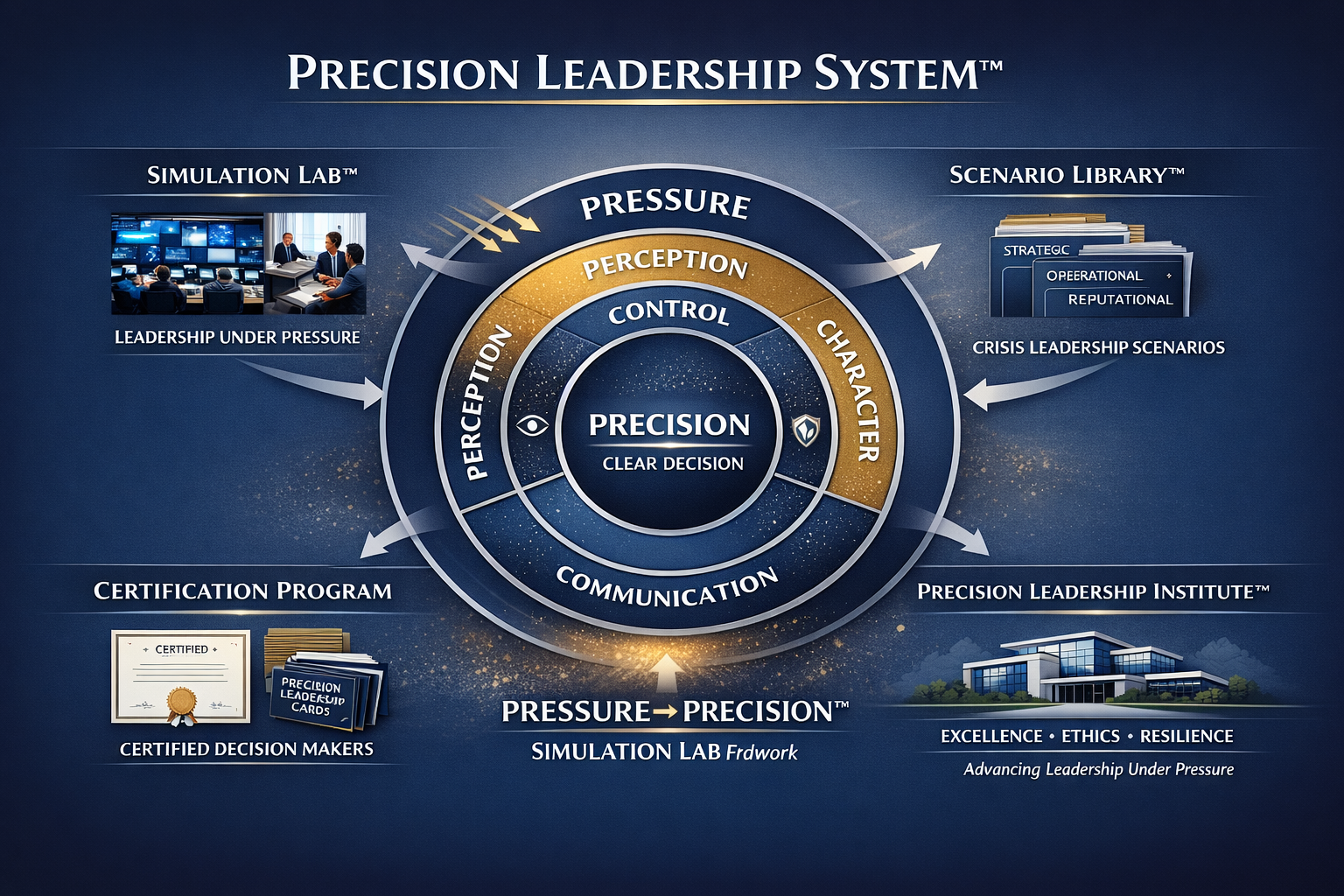
Pressure → Perception → Control → Character → Precision

The Stoic element isn’t separate from your Compass. It runs through the entire sequence.

3. Perception comes before action
Marcus Aurelius repeatedly returned to the importance of examining one’s impressions before accepting them as reality.

An event occurs.

Then we interpret it.

Then we respond.

Those are not the same thing.

This maps beautifully onto Precision Leadership:

EVENT → PERCEPTION → JUDGMENT → RESPONSE

Under pressure, leaders frequently collapse those four stages into one:

EVENT → REACTION

Stoic training creates space between stimulus and response.

Precision Leadership teaches leaders to operate intelligently within that space.

And Stulberg’s emphasis on attention and focus strengthens the same capacity.

Thus:

Stoicism trains perception. Precision Leadership operationalizes it.
Sep 26, 2026 - Musings    No Comments

Leading in Uncertainty

This worksheet was created by Brian Johnson at Heroic.us For exceptionally helpful information to support your personal development and resourcefulness go to: https://www.heroic.us/

Change is accelerating. These five practices help you lead well without knowing exactly what comes next.

1 Regulate

• Your energetic state communicates more than your words.

• Practice: Your Perfect Breath: breathe through the nose, into the belly, and exhale. Aim for about 5.5 breaths per minute, or count by your heartbeat: 5 in, 5 out | 6 in, 1 hold, 8 out | 5 in, 5 hold, 5 out, 5 hold.

• Use it: In planned or unplanned transitions, including the 60 seconds between calls.

2 Embrace reality

• Stories are not reality. You can see a situation clearly without liking it.

• Practice: Write the challenge as facts only. If a statement is a judgment, debatable, or viewed differently by someone else, it is not a fact. Say: “Yes, this is what is happening. And here is what I can do from here.”

• Use it: When news lands or before replying to an email that spikes your reaction.

3 See a better future

• Give people a goal, a sense of agency, and possible pathways.

• Practice: “The better future I am leading this team toward is _____. How I can help those I lead see themselves in it: _____. The first move this week is _____.”

• Use it: In group meetings and one-to-one conversations.

4 Create stability

• People expect some change. They also want to know what they can rely on.

• Practice: “The values and behaviors I am committed to putting into practice, and that my team can count on, are _____.”

• Use it: To guide your behavior consistently.

5 Grow stronger from obstacles

• Use challenges as fuel for growth.

• Practice: Name the obstacle. Ask how it might prepare you for what comes next: “This challenge is training me to _____.”

• Use it: In a Friday review: What was hardest this week, and what is it forging?

You can only lead others as effectively as you lead yourself.

The one I am starting today: ______________________________________________

The Leadership Accelerator • Eight live Tuesdays, a cohort, and your Performance & Flourishing Score measured in weeks one and eight.

Starts Tuesday, October 13. Doors close Monday, October 12, 11:59 p.m. ET. heroic.us/leadership-accelerator

DAY 1. ALL IN. LET’S GO.

Sep 25, 2026 - Musings    No Comments

Bitcoin Is for Everyone

Basic Concepts and Key Lessons

Author: Natalie Brunell
Subtitle: Why Our Financial System Is Broken and Bitcoin Is the Solution
Published: 2025

Natalie Brunell—financial journalist and host of the Coin Stories podcast—writes for readers who are curious about Bitcoin but may find the subject technical or intimidating. Her central argument is that Bitcoin should be understood not merely as a speculative investment, but as an alternative monetary system designed to protect human effort, property, and freedom.

1. Something is fundamentally wrong with money

  • Brunell begins with a problem familiar to ordinary families:
    • Housing, education, healthcare, food, and other necessities are becoming less affordable.
    • Many people are working harder but feel they are falling further behind.
    • Wages frequently fail to keep pace with the rising cost of living.
    • Younger generations increasingly doubt that they will achieve the financial security their parents enjoyed.
  • She argues that these difficulties are connected to the monetary system—not simply to personal choices, insufficient effort, or individual financial mistakes.
  • Modern money can be created in enormous quantities by governments and central banks.
  • When the money supply expands faster than the production of goods and services, each unit of currency may gradually lose purchasing power.
  • Inflation therefore acts like a hidden tax:
    • The same number of dollars buys fewer goods.
    • Cash savings lose purchasing power over time.
    • People who do not own appreciating assets are especially vulnerable.

2. The system rewards asset owners more than wage earners

  • Newly created money does not reach everyone at the same time or produce equal benefits.
  • Financial institutions, corporations, governments, and wealthy investors are often positioned to receive or benefit from inexpensive capital first.
  • People who own stocks, businesses, and real estate may see their wealth rise as asset prices increase.
  • People who depend primarily on wages experience the other side of the process:
    • Higher living costs
    • More expensive homes
    • Greater reliance on debt
    • Reduced ability to save
    • Increasing financial insecurity
  • Brunell presents this as a structural problem, not necessarily a conspiracy: the rules of the system naturally favor those closest to money creation and financial assets.

3. Money represents stored human time and effort

  • People exchange their time, energy, judgment, and skills for money.
  • Money should allow them to preserve that value for future use.
  • If money continually loses purchasing power, part of the value of a person’s past labor effectively disappears.
  • Brunell therefore treats sound money as a moral issue:
    • Can people preserve the results of honest work?
    • Can they plan confidently for the future?
    • Can they save without being forced into risky investments?
    • Can governments change the supply of money without citizens’ direct consent?
  • Good money should perform three primary functions:
    • Medium of exchange: It can be used to purchase goods and services.
    • Unit of account: It provides a common way to measure prices.
    • Store of value: It preserves purchasing power across time.

4. Trust is the central weakness of conventional money

  • Traditional financial systems require people to trust multiple institutions:
    • Governments to manage the currency responsibly
    • Central banks to control inflation
    • Commercial banks to safeguard deposits
    • Payment companies to process transactions
    • Regulators to enforce the rules fairly
  • These institutions can provide valuable services, but they can also:
    • Change monetary policies
    • Freeze or restrict accounts
    • Block transactions
    • Create more currency
    • Fail because of poor management
    • Apply rules differently across countries or populations
  • The dollar remains globally important because it is widely accepted, relatively liquid, and supported by powerful economic and political institutions.
  • However, Brunell argues that reliance on the dollar does not eliminate long-term concerns about debt, money creation, and purchasing-power erosion.

5. Bitcoin offers a different set of rules

  • Bitcoin was introduced in 2009 as a decentralized digital monetary network.
  • It does not have a central bank, corporate owner, or government administrator.
  • Its essential rules are enforced by software and a globally distributed network.
  • Bitcoin’s maximum supply is fixed at 21 million units.
  • This scarcity is intended to prevent discretionary money creation and long-term dilution.
  • Brunell contrasts the two monetary models:
Conventional currencyBitcoin
Supply can be expandedMaximum supply is fixed
Controlled by central authoritiesOperated by a decentralized network
Rules can change through policyCore rules require network consensus
Accounts depend on intermediariesUsers can hold assets directly
Transactions may be restrictedNetwork participation is broadly open

6. Bitcoin replaces institutional trust with verification

  • Bitcoin does not eliminate trust in every human interaction, but it reduces the need to trust a single monetary authority.
  • Transactions are recorded on a public ledger called the blockchain.
  • Independent computers known as nodes verify whether transactions comply with the network’s rules.
  • The software is open source, allowing technically qualified people to inspect and test it.
  • No individual participant can simply create additional bitcoin or rewrite the ledger at will.
  • This gives rise to one of Bitcoin’s defining principles: “Don’t trust; verify.”
  • Brunell considers verification important because equal rules create a monetary system in which powerful participants cannot easily grant themselves special privileges.

7. Energy gives Bitcoin physical security

  • Bitcoin mining uses computing equipment and electrical energy to:
    • Process blocks of transactions
    • Secure the transaction history
    • Make attacks expensive
    • Distribute newly issued bitcoin according to transparent rules
  • Brunell presents energy consumption as a security feature rather than an accidental waste.
  • Mining converts real-world resources into digital monetary security.
  • She also argues that mining can sometimes use:
    • Stranded or otherwise wasted energy
    • Renewable electricity that lacks immediate buyers
    • Excess power during periods of low demand
    • Methane that might otherwise be released or flared
  • Nevertheless, Bitcoin’s environmental consequences remain debated. The quality of its impact depends heavily on where miners operate and which energy sources they use.

8. Bitcoin is an “Internet of money”

  • Anyone with an internet connection can potentially participate without needing permission from a bank.
  • Bitcoin can be transferred across national boundaries without relying exclusively on traditional payment networks.
  • This may be particularly valuable to:
    • People living under unstable currencies
    • Migrant workers sending money home
    • Individuals without reliable banking services
    • Citizens facing capital controls
    • People seeking portable property during political or economic instability
  • Bitcoin is divisible into 100 million smaller units called satoshis, so someone does not need to purchase an entire bitcoin.
  • Brunell’s phrase “Bitcoin is for everyone” means that the network is open to participation—not that everyone is guaranteed to profit or should invest without careful study.

9. Self-custody creates both freedom and responsibility

  • Bitcoin allows people to hold their wealth without depending entirely on a bank or exchange.
  • Control is established through cryptographic private keys.
  • Self-custody can provide:
    • Greater financial independence
    • Stronger protection against institutional failure
    • Portability across borders
    • Resistance to arbitrary confiscation or censorship
  • But independence introduces serious responsibilities:
    • A lost private key may mean permanently lost bitcoin.
    • A stolen recovery phrase can allow a thief to take the funds.
    • Fraudulent exchanges and investment schemes remain common.
    • Transactions generally cannot be reversed.
  • Becoming “your own bank” therefore requires education, secure backups, careful procedures, and resistance to scams.

10. Bitcoin encourages long-term thinking

  • Brunell connects sound money with a concept sometimes called low time preference—placing greater value on long-term wellbeing than immediate gratification.
  • If people believe their savings will preserve value, they may be more willing to:
    • Save rather than consume immediately
    • Build durable businesses
    • Invest in education and skills
    • Plan across generations
    • Exercise patience and personal responsibility
  • In this view, money influences culture. A monetary system based on scarcity may encourage discipline, delayed gratification, and stewardship.

11. Bitcoin is presented as hope—not a guaranteed outcome

  • Brunell sees Bitcoin as a peaceful alternative to a financial system increasingly shaped by debt and monetary expansion.
  • Its potential rests on voluntary adoption rather than government mandate.
  • The book’s larger message is one of individual empowerment:
    • Learn how money works.
    • Question systems that quietly reduce purchasing power.
    • Take responsibility for protecting the value of your labor.
    • Think independently instead of accepting conventional assumptions.
    • Consider how transparent and predictable monetary rules might strengthen human freedom.

Important balance and cautions

  • The book presents a strongly pro-Bitcoin case; readers should also examine credible opposing arguments.
  • Bitcoin still carries substantial risks:
    • Extreme price volatility
    • Regulatory uncertainty
    • Theft, fraud, and custody mistakes
    • Dependence on continued network participation
    • Technical complexity
    • Environmental concerns
    • No government guarantee or deposit insurance
    • Uncertainty about its eventual level of global adoption
  • Bitcoin’s limited supply does not guarantee that its market price will rise. Price ultimately depends on demand, confidence, liquidity, regulation, and continued adoption.
  • A person should distinguish among three separate propositions:
    • Bitcoin is an innovative monetary network.
    • Bitcoin possesses qualities that could make it a long-term store of value.
    • Buying Bitcoin at a particular price is appropriate for a particular individual.
  • Accepting the first or second proposition does not automatically establish the third.

Bottom line

  • Brunell’s central thesis is that today’s financial distress begins partly with money that can be expanded and devalued.
  • Bitcoin offers an alternative based on scarcity, transparency, decentralization, verification, and individual ownership.
  • Its greatest promise, in the author’s view, is not rapid wealth. It is a monetary system in which people can preserve the value of their work under rules that no government, corporation, or privileged individual can easily change.
  • The book ultimately asks readers to reconsider a foundational question: What kind of money best protects human time, dignity, freedom, and hope for the future?

Sources

Sep 12, 2026 - Musings    No Comments

Courage as a Life-Value

As a Stoic virtue Courage is the virtue that helps you do the right thing when fear, pain, uncertainty, or pressure are present. In Stoic thinking, courage is not recklessness and not the absence of fear. It is disciplined action in service of what is right.

Stoic courage works alongside the other virtues:

  • Wisdom shows what is true and what matters.
  • Courage moves you to act on that truth.
  • Temperance keeps the action disciplined and proportional.
  • Justice gives the action moral purpose.

So courage is what helps you endure difficulty without abandoning principle.

As a leadership skill
Courage is a leadership skill because leadership often requires action before certainty arrives. A leader may need to:

  • make a hard decision,
  • deliver an uncomfortable truth,
  • admit a mistake,
  • confront poor performance,
  • protect the team’s standards,
  • or choose long-term integrity over short-term approval.

Without courage, leaders can become passive, conflict-avoidant, or overly dependent on consensus. Courage helps a leader preserve clarity under pressure and act responsibly when others hesitate.

As a daily practice
Courage becomes real through repetition. You build it in small moments:

  • telling the truth when a lie would be easier,
  • asking a question when you feel uncertain,
  • saying no when pressure says yes,
  • starting the task you have been avoiding,
  • admitting you were wrong,
  • or having a respectful difficult conversation.

A useful daily test is:

  • What am I avoiding?
  • What fear is driving that avoidance?
  • What is the smallest responsible brave action I can take today?

That is how courage becomes a habit rather than a one-time dramatic act.

In short:

  • Stoic virtue: courage helps you act rightly under pressure.
  • Leadership skill: courage helps you lead when conditions are unclear or uncomfortable.
  • Daily practice: courage grows through small, repeated acts of responsible action.
Sep 12, 2026 - Musings    No Comments

Courage is Calling

Ryan Holiday — Two-Page Summary

Central message

  • Courage is one of the four cardinal Stoic virtues, alongside wisdom, justice, and self-discipline.
  • Holiday describes courage as the foundational virtue because the other virtues accomplish little unless we have the courage to practice them.
  • Courage is not the absence of fear. It is the decision to move forward despite fear—when judgment, duty, or conscience tells us that action is necessary.
  • Every person repeatedly faces a choice between:
    • Fear and courage
    • Comfort and growth
    • Self-protection and service
    • Silence and truth
    • Avoidance and responsibility
  • Courage is not reserved for soldiers, political leaders, or historical heroes. It is required in ordinary life: having a difficult conversation, admitting a mistake, beginning an uncertain project, standing against wrongdoing, or helping someone in danger.
  • The book is organized around three ascending levels: Fear, Courage, and Heroism. Fear must be understood and managed; courage must be practiced; heroism occurs when courage is placed in the service of others. 

Part I: Fear

  • Fear is natural. It is an evolutionary warning system intended to protect us from danger.
  • The problem is not experiencing fear. The problem arises when fear controls our judgment, narrows our perception, or prevents us from fulfilling our responsibilities.
  • Many modern fears concern possibilities rather than immediate dangers:
    • Fear of failure
    • Fear of embarrassment
    • Fear of criticism
    • Fear of losing status
    • Fear of uncertainty
    • Fear of being different
    • Fear of making the wrong decision
  • We often suffer more from imagining what might happen than from what actually happens.
  • Fear exaggerates obstacles. It tells us that discomfort will be unbearable, failure will be permanent, and criticism will destroy us.
  • Cowardice frequently appears in respectable disguises:
    • “I need more information.”
    • “This isn’t the right time.”
    • “Someone else will handle it.”
    • “I’m only being realistic.”
    • “There is nothing I can do.”
  • Excessive caution can become a form of self-deception. Preparation is valuable, but endless preparation may simply postpone the moment when action is required.
  • Anxiety focuses attention on what might go wrong. Preparation asks what can be done now.
  • The Stoic response is to separate reality from imagination:
    • What are the facts?
    • What am I assuming?
    • What is actually dangerous?
    • What discomfort am I merely trying to avoid?
    • What remains within my control?
  • Fear becomes more powerful when we avoid it. Every act of avoidance teaches the mind that the feared situation is too dangerous to face.
  • Conversely, taking small courageous actions builds evidence that we can tolerate discomfort and uncertainty.
  • Holiday therefore treats courage as a habit. We must practice it in ordinary moments so that it is available during extraordinary ones.

Part II: Courage

  • Courage means acting according to one’s principles even when the outcome is uncertain.
  • It is not impulsiveness, recklessness, aggression, or thrill-seeking. Genuine courage is guided by judgment and directed toward a worthy purpose.
  • Recklessness ignores danger. Courage sees danger clearly, prepares intelligently, and acts when action is justified.
  • Courage begins with accepting reality. Denial does not make a difficult situation safer; it only delays an effective response.
  • We develop courage by moving toward what frightens us in manageable steps.
  • Preparation reduces unnecessary fear:
    • Study the situation.
    • Strengthen the required skills.
    • Anticipate likely problems.
    • Decide beforehand what principles cannot be compromised.
    • Create contingency plans.
    • Then act.
  • Competence supports courage. The better prepared we are, the less mental energy fear can consume.
  • Courage often requires initiative. The courageous person does not wait for perfect conditions, unanimous approval, or guaranteed success.
  • There is rarely a completely safe moment to begin something important.
  • Failure is not necessarily evidence that an action was mistaken. A person can make a courageous and ethical decision that produces an unfavorable outcome.
  • We should judge ourselves primarily by the quality of our choices, effort, and character—not by outcomes we could not fully control.
  • Moral courage may be more difficult than physical courage because it can require:
    • Standing alone
    • Risking reputation or employment
    • Challenging authority
    • Defending an unpopular truth
    • Admitting personal wrongdoing
    • Refusing to participate in unethical conduct
  • Speaking honestly is courageous, but courage is not an excuse for cruelty. Truth should be expressed with judgment, restraint, and respect.
  • Leadership requires courage because leaders must make decisions before every uncertainty has been removed.
  • A courageous leader:
    • Faces unpleasant facts.
    • Accepts responsibility.
    • Communicates honestly.
    • Protects people rather than personal status.
    • Makes the necessary decision.
    • Remains teachable enough to change course.
  • Courage is contagious. One person’s example can give others permission to act. Fear and passivity can spread in exactly the same way. Holiday explicitly emphasizes that courage can be strengthened through repeated practice. 

Part III: Heroism

  • Heroism is courage elevated beyond personal ambition.
  • Ordinary courage asks, “Can I face this?” Heroic courage asks, “Who needs me to face this?”
  • Courage becomes heroic when it serves:
    • Another person
    • A community
    • A moral principle
    • A future generation
    • A cause greater than personal comfort
  • Heroism does not require fame, public recognition, or dramatic sacrifice. Quiet acts of service may be genuinely heroic.
  • A heroic person accepts personal risk or inconvenience because protecting others matters more than remaining comfortable.
  • The highest courage is not concerned with appearing brave. It focuses on doing what the situation requires.
  • Heroism includes compassion. Courage without concern for others can become vanity, domination, or aggression.
  • We should not wait for someone else to intervene. Responsibility often belongs to the person who sees what needs to be done.
  • History’s courageous figures were not necessarily fearless or flawless. They became important because they acted at decisive moments despite uncertainty and personal limitations.
  • Small decisions prepare us for larger tests. Character is formed long before the crisis that reveals it.

Holiday’s practical lessons

  • Name the fear clearly; vague fear is harder to manage.
  • Distinguish genuine physical danger from discomfort, embarrassment, or uncertainty.
  • Focus on what is within your control: preparation, effort, judgment, conduct, and response.
  • Take the smallest meaningful action instead of waiting to feel confident.
  • Practice voluntary discomfort so that comfort does not become a requirement for action.
  • Tell the truth, particularly when silence would protect you at someone else’s expense.
  • Ask for help when necessary; courage does not require solitary struggle.
  • Admit mistakes promptly. Defending an error because of pride is another form of cowardice.
  • Choose worthy causes. Courage employed for an unjust purpose is not virtue.
  • Protect people with less power, even when doing so carries a cost.
  • Remember that courage grows through use. Each courageous decision makes the next one more attainable.

Final takeaway

  • Courage Is Calling presents life as a continuing series of invitations to act with greater bravery.
  • The question is not whether we feel afraid. The question is whether fear will determine our behavior.
  • Holiday’s essential formula can be summarized as:See reality clearly → prepare intelligently → control what you can → act despite fear → use courage in service of others.
  • The ultimate goal is not simply to become bolder. It is to become dependable—the person who can be counted on to do the right thing when circumstances are difficult, uncertain, or dangerous.
  • For leadership, the book’s strongest lesson is this: Courage converts values from ideas into action. Without it, integrity, justice, wisdom, and service remain intentions rather than lived character.
Pages:«12345678...45»